Over the past few days, a very spirited debate has emerged surrounding the war in Iran. My article on Sunday helped ignite some of that discussion, receiving more than one and a half million views on social media along with some passionate responses. And that debate is exactly what should happen in moments like this, because debate is healthy. It is needed, and it exposes the collective heartbeat of a nation when people are confronted with serious decisions.
The questions raised in that article were not meant to inflame anyone. They were the questions we should all expect our leaders to ask before American troops are placed in harm’s way and the United States becomes militarily involved in something of this magnitude. But once the first shots are fired, the why quickly becomes less important than the what and the how, and that is where our focus needs to be now.
Limiting the President’s powers, as some members of Congress attempted this week, is not a solution. If Congress truly intended to adhere to its own war powers, it had forty-seven years to do so. Instead, they passed the buck to the President in 1973 and never looked back. This is remarkably evident in discussions surrounding the Beirut bombing of 1983, a topic being mentioned frequently right now. Even then, rather than assert its authority directly, Congress handed the responsibility to President Reagan and later pretended the outcome was his failure rather than their own abdication. But again, that is all part of the why.
Right now, the only mission is to ensure that what has already begun is finished as safely and efficiently as possible, and in a way that ensures our objectives are actually achieved. Not like Iraq. Not like Afghanistan. This time we must do it differently. For now, the Administration’s projected end state still appears somewhat ambiguous; but if I were sitting in Congress today, I would be focused on establishing these clear objectives.
Objective One:
This conflict must end with the removal of the current Iranian regime. The United States and Israel have both made it clear that there is no workable alternative while the current leadership structure remains intact. As long as fragments of that regime continue attempting to maintain power, military pressure will and should continue. Regardless of how, achieving this objective must be done quickly so that regional stability can be restored, because the more rockets that fly, the more this has the potential to escalate to a point of no control.
It appears Kurdish forces are now beginning assaults, which is a positive development. But it also means they need weapons, supplies, communications, advisors, and air support. This is something I only see happening with the rapid nature it requires if American forces are actively operating inside Iran. And whether it is before the regime is finally brought down or after, I cannot imagine any scenario where at a minimum special forces, advisory troops, and peacekeeping missions do not find boots on Iranian soil.
Objective Two:
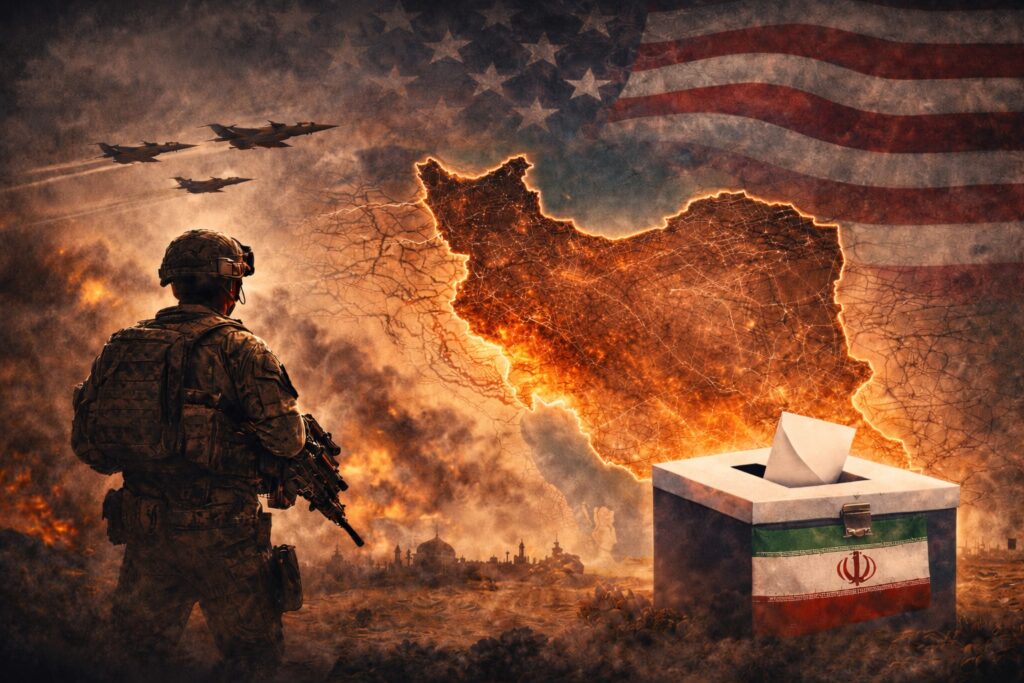
Iran must hold timely national elections that are genuinely free of corruption. President Trump has stated publicly that this is the Iranian people’s moment. If the United States has opened that window of opportunity, then we have a responsibility to ensure it is not stolen from them.
It is also important to remember that this story did not begin forty-seven years ago. American intervention helped install the Shah in the 1940s and reinforced him a decade later. We must remember those decisions contributed to the revolution that followed and remain mindful of the future ramifications of repeating past mistakes. If Iran is now being given the opportunity to determine its own future, the process must be transparent and legitimate. The Iranian people must be able to choose their own leadership without manipulation or coercion, and it must be open for the world to see.
This will undoubtedly be the most challenging objective. It is where we have failed so miserably in the past, as evidenced by the nations both directly east and directly west of Iran. But third time’s a charm, as they say, and if we actually get this one right, we have the opportunity to reshape the entire landscape of the Middle East into a much more stable environment.
Objective Three:
Preparations must begin immediately for the long-term care of American veterans involved in this conflict. Every modern war eventually produces health consequences that were not fully understood at the time. Agent Orange and burn pit exposure are two examples that required years of legislative battles before veterans received proper care.
If I were in Congress today, I would introduce a bill ensuring this objective is met before the conflict even ends. I would also include provisions requiring that any new conflict trigger immediate coordination between the Department of Defense and the Department of Veterans Affairs to begin documenting potential exposures, establishing medical monitoring, and preparing the administrative structures necessary to process future claims free of administrative obstacles or legislative lag. These efforts should always begin at the onset of conflict, not decades later.
Objective Four:
If the previous objectives are achieved, the final step must be stabilization through economic integration. A new Iranian government should have the opportunity to establish strong economic ties with the United States and the broader international community. A formal peace agreement and open economic engagement would obviously help stabilize Iran and potentially influence positive change across the region. If such a transition were successful, it could create new opportunities to strengthen stability in Iraq, Yemen, Syria, and even Afghanistan over time. And in that scenario, President Trump would indeed be remembered as the leader who reshaped the region and prevented a far more dangerous outcome.
And this outcome is possible. But it will only happen if the objectives are clearly defined and pursued deliberately. If a new Iranian government emerges, it will need immediate support to secure the country, stabilize its institutions, and prevent chaos during the transition. That means providing equipment, logistical support, and other ancillary support for Iranian forces to ensure the transition of power happens quickly and legitimately.
And no one despises the military industrial complex more than me. But at this point, that does not matter, either. What we started must be finished, period. And if the Iranian people are truly being given a chance to determine their own future, then the responsibility now falls on us to ensure that opportunity becomes reality. The debate about why this began will continue. But right now, the focus must be on how it ends.